
MENU
Exhibitor Forum
EXHIBITION: January 27-29, 2026
At the Exhibitor Forum, exhibitors deliver a series of 15-minute presentations, introducing their latest technologies, products, and initiatives. Explore current trends and innovations in a relaxed and open atmosphere!
Date: January 27- 29, 2026
Venue: 3F Event Hall
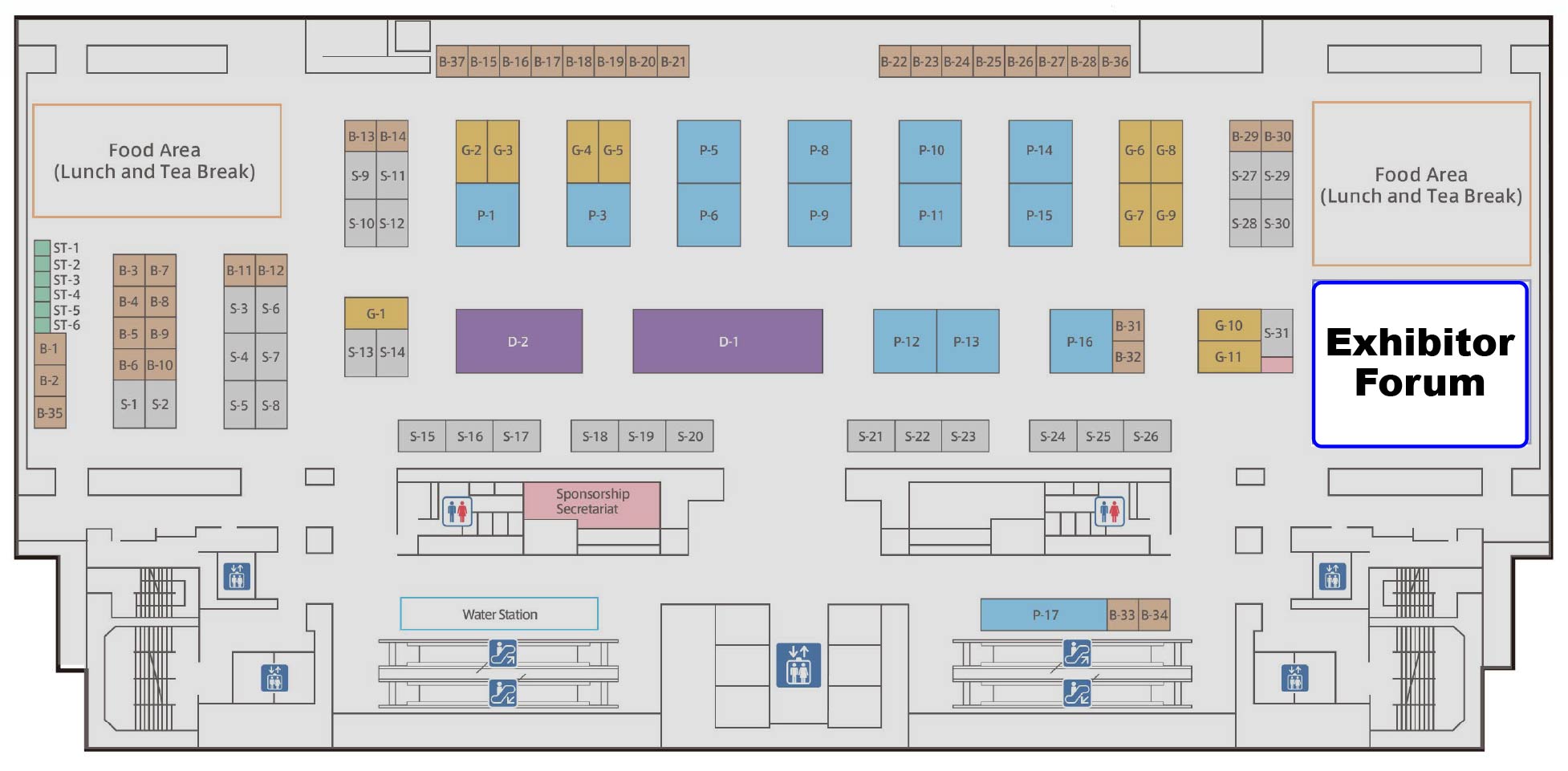
Click to see the detailed floor plan of the Event Hall
Tue, Jan 27
| NO. | Time | Sponsor |
|---|---|---|
| 1 | 11:20-11:35 | GMO Internet, Inc. |
| 2 | 11:40-11:55 | NVIDIA G.K. |
| 3 | 12:00-12:15 | NSCC Singapore |
| 4 | 12:20-12:35 | Hewlett Packard Enterprise |
| 5 | 12:40-12:55 | Hewlett Packard Enterprise |
| 6 | 13:00-13:15 | Pure Storage Japan |
| 7 | 13:20-13:35 | IQM Quantum Computers |
| 8 | 13:40-13:55 | Super Micro Computer, Inc. |
| 9 | 14:00-14:15 | Giga Computing Co., Ltd. |
| 10 | 14:20-14:35 | Western Digital Marketing G.K. |
| 11 | 14:40-14:55 | NetApp G.K. |
| 12 | 15:00-15:15 | IBM Japan, Ltd. |
| 13 | 15:20-15:35 | SoftBank Corp./ SB Intuitions Corp. /Arm Limited |
| 14 | 15:40-15:55 | XENON Global Technologies |
| 15 | 16:00-16:15 | Slurm |
| 16 | 16:20-16:35 | QUDORA Japan KK |
| 17 | 16:40-16:55 | QuEra Computing, Inc. |
Wed, Jan 28
| NO. | Time | Sponsor |
|---|---|---|
| 1 | 10:40-10:55 | WEKA |
| 2 | 11:00-11:15 | Vertiv |
| 3 | 11:20-11:35 | NEC Corporation |
| 4 | 11:40-11:55 | DataDirect Networks |
| 5 | 12:00-12:15 | Amazon Web Services |
| 6 | 12:20-12:35 | VAST Data |
| 7 | 12:40-12:55 | CSC - IT Center for Science / LUMI Supercomputer |
| 8 | 13:00-13:15 | The Siemon Company |
| 9 | 13:20-13:35 | Do IT Now |
| 10 | 13:40-13:55 | xFusion Technologies Japan K.K. |
| 11 | 14:00-14:15 | Digital Research Alliance of Canada |
| 12 | 14:20-14:35 | TOKYO ELECTRON DEVICE LTD. |
| 13 | 14:40-14:55 | OpenWebSearch.eu |
| 14 | 15:00-15:15 | Quantinuum |
| 15 | 15:20-15:35 | nVent Japan/Kawamura Electric Inc |
| 16 | 15:40-15:55 | Fixstars Corporation |
| 17 | 16:00-16:15 | Okinawa Institute of Science and Technology |
| 18 | 16:20-16:35 | High Performance Software Foundation |
| 19 | 16:40-16:55 | ThinkParQ GmbH |
Thu, Jan 29
| NO. | Time | Sponsor |
|---|---|---|
| 1 | 11:00-11:15 | ASUS JAPAN |
| 2 | 11:20-11:35 | Lenovo |
| 3 | 11:40-11:55 | CORE MICRO SYSTEMS INC. |
| 4 | 12:00-12:15 | Sakura Internet Inc. |
| 5 | 12:20-12:35 | QORGA Corporation |
| 6 | 12:40-12:55 | Research Organization for Information Science and Technology |
| 7 | 13:00-13:15 | Intel K.K. |
| 8 | 13:20-13:35 | Linaro |
| 9 | 13:40-13:55 | Arista Networks Japan Limited. |
| 10 | 14:00-14:15 | Siemens Digital Industries Software |
| 11 | 14:20-14:35 | Qilimanjaro |
| 12 | 14:40-14:55 | Cerebras |
| 13 | 15:00-15:10 | Fujitsu Limited |
| 14 | 15:15-15:25 | Google Cloud Japan G.K. |
- January 27 (Tue)
- January 28 (Wed)
- January 29 (Thu)
Tue, January 27, 2026 11:20 - 11:35 3F Event Hall
Speaker
- Yuji Fujima, Product Management Team, Domain & Cloud Division, GMO Internet, Inc.
Session description
This session presents an overview of GMO Internet, Inc.’s GPU cloud service initiatives and provides an introduction to the Lunch Speaker Session and booth exhibitions.
Tue, January 27, 2026 11:40 - 11:55 3F Event Hall
Speaker
- Jeff Larkin, Director
Session description
Industrial engineering is undergoing a significant transformation, propelled by advancements in accelerated computing, AI Physics, and digital twins. This presentation will detail how these hardware and software innovations are helping to compress engineering design cycles and accelerate research and development.
We will deep-dive into mixed-precision techniques, new ML architectures, emerging quantum computing applications and the evolution of GPU hardware. Through real-world use cases from the automotive, aerospace, and semiconductor industries, this session will provide the HPC community with actionable insights into how AI-driven simulation and accelerated computing is fundamentally reshaping the industrial engineering landscape.
Tue, January 27, 2026 12:00 - 12:15 3F Event Hall
Speaker
- Stefano Carrazza - Associate Professor, University of Milan and INFN Milan
Session description
Discover Qibo, an open-source middleware for quantum computing and hybrid-quantum-classical integration. Singapore’s National Quantum Computing Hub (NQCH) is part of the global network contributing to the development of this full-stack option. Qibo supports the entire quantum workflow, from high-level algorithm development and large-scale simulation to low-level hardware control and execution on physical quantum processors. These tools are deployed on the Hub’s superconducting quantum processor. Learn more at nqch.sg
Tue, January 27, 2026 12:20 - 12:35 3F Event Hall
Speaker
- Christopher Davidson, VP, HPC and AI Customer Solutions, HPE
Session description
The convergence of AI and scientific computing requires new agile, hybrid models for innovation that balance performance, sovereignty, and trust. In this session, HPE and AMD share insights from global deployments of sovereign AI and HPC systems supporting scientific discovery, national research, and industry. Learn how next generation architectures, open ecosystems, and sustainable design are enabling the future of sovereign AI and scientific discovery.
Tue, January 27, 2026 12:40 - 12:55 3F Event Hall
Speaker
- Christopher Davidson, VP, HPC and AI Customer Solutions, HPE
Session description
Generative, agentic, and physical AI have the potential to transform global productivity and create lasting societal change, but AI is only as good as the infrastructure and data behind it. You need the data, intelligence, and vision to capture the AI opportunity, which makes securing the right IT foundation essential. Learn how HPE and NVIDIA deliver comprehensive, modular AI factory solutions to optimize and scale AI, powering scientific research, discovery, and more sustainable business value.
Tue, January 27, 2026 13:00 - 13:15 3F Event Hall
Speaker
- Yifeng Jiang, Principal Field Solutions Architect / APJ Specialist Field Tech
Session description
Do we want to build an AI Factory, or an AI Data Platform?
This leads to very different decision criteria, but one thing in common here is data.
In this session, We will talk about the decision matrix of AI infrastructure, and how Pure Storage helps in accelerating data readiness for AI/HPC, whether it is for AI Factory or AI Data Platform.
We will introduce Pure's most performant and scalable storage FlashBlade//EXA for AI Factory, and the technology behind FlashBlade//EXA.
We will also share a preview of Pure's Data Stream, an implementation of NVIDIA's AI Data Platform (and much more) that is designed to accelerate AI application deployment from months to minutes.
Tue, January 27, 2026 13:20 - 13:35 3F Event Hall
Speaker
- Eric Mansfield
Session description
Incorporating Quantum Computing (QC) into High Performance Computing (HPC) environments (commonly referred to as HPC+QC integration) marks a pivotal step in advancing computational capabilities for scientific research. In this talk, we share a firsthand account of integrating a superconducting 20-qubit quantum computer into the HPC infrastructure at LRZ Supercomputing Center in Germany, one of the first practical implementations of its kind. This yielded four key lessons: (1) quantum computers have stricter facility requirements than classical systems, yet their deployment in HPC environments is feasible when preceded by a rigorous site survey to ensure compliance; (2) quantum computers are inherently dynamic systems that require regular recalibration that is automatic and controllable by the HPC scheduler; (3) redundant power and cooling infrastructure is essential; and (4) effective hands-on onboarding should be provided for both quantum experts and new users. By sharing these experiences, we aim to provide a roadmap for other HPC centers considering similar integrations.
Tue, January 27, 2026 13:40 - 13:55 3F Event Hall
Speaker
- Akira Sano, General Manager FAE & Business Development
Session description
Supermicro DCBBS builds optimized HPC with Plug&Play services, from custom design to implementation.
Tue, January 27, 2026 14:00 - 14:15 3F Event Hall
Speaker
- Leo Lin
Session description
Redefine the future datacenter via scaling servers and advanced cooling solutions
Tue, January 27, 2026 14:20 - 14:35 3F Event Hall
Speaker
- Jason Strawderman, Senior Director, WW Platforms Business Development - Western Digital Corporation
Session description
As AI data pipelines and HPC workloads reshape data-center design, disaggregated storage over high-speed ethernet fabrics is emerging as the foundation of performance, scalability, and efficiency. By aligning low-latency flash tiers for real-time training, inference, and simulation with cost-optimized QLC flash and HDD for model repositories, datasets, and checkpoints, data centers can fluidly balance speed and capacity. This new architecture unifies workflows - accelerating innovation, simplifying scale, and redefining the economics of data-driven discovery. Join us to explore a forward-looking vision for infrastructure innovation and how it’s shaping the future of intelligent workloads.
Tue, January 27, 2026 14:40 - 14:55 3F Event Hall
Speaker
- Masahiro Waki,
AI/DX Strategic Business Development Lead
Senior Business Development Manager
NetApp G.K.
Session description
NetApp enables Japan's AI for Science initiatives with secure, integrated, and advanced intelligent data infrastructure.
By leveraging strategic partnerships with leading AI companies like NVIDIA, AWS, Microsoft, and Google Cloud, NetApp provides AI-ready data platforms that simplify complex AI data processes and accelerate scientific research. NetApp's solutions, such as AFX and AI Data Engine, offer performance, flexibility, and control, ensuring efficient, compliant, and secure data handling.
Committed to supporting efforts led by RIKEN, HPCI, and the Japanese government, NetApp facilitates breakthrough discoveries in various fields, including life sciences and material sciences, through innovative data management and hybrid cloud integration.
Tue, January 27, 2026 15:00 - 15:15 3F Event Hall
Speaker
- Hiroshi Horii, Head of IBM Quantum Japan
- Tatsuhiro Chiba, Senior Technical Staff Member, AI Infrastructure, IBM Research
Session description
We would like to introduce the highlights of IBM's Lunch Speaker Session, Keynote Speakers Session, Invited Session, and Fugaku tour. We will also introduce IBM's initiatives in the fields of IBM Quantum, IBM Vela/AIU and IBM Storage.
Tue, January 27, 2026 15:20 - 15:35 3F Event Hall
Speaker
- Masashi Horikoshi, Principal HPC Engineer, SB Intuitions Corp.
Session description
We introduce Sarashina, Japan’s cutting-edge LLM developed by SB Intuitions. This session explores the infrastructure demands for LLM training and inference, highlighting our innovative solutions to optimize performance and scalability. We discuss our AI-optimized environments across data centers, enabling efficient model training while addressing resource challenges. Furthermore, we demonstrate how these platforms facilitate Sarashina’s lightning-fast inference and seamless integration with third-party services, unlocking new possibilities for enterprise AI applications. Join us to discover how we’re redefining AI infrastructure for next-gen intelligence.
Tue, January 27, 2026 15:40 - 15:55 3F Event Hall
Speaker
- Werner Scholz, CTO and Head of R&D Xenon Systems
Session description
Cluster management tools and user interfaces are often the neglected layer between the users, their applications and the cluster hardware. But can a thoughtfully architected HPC cluster software stack enable modern cluster design, regardless of where the hardware lives, and include support for a broad range of platforms and applications from classic scientific codes to modern prebuilt container images?
Learn how XENON Cluster Stack frees one from vendor and/or cloud lock-in and allows for infrastructure flexibility, modular expansion, and easy customisation for heterogeneous clusters. This results in an agile infrastructure that is composable and enables experimentation.
Tue, January 27, 2026 16:00 - 16:15 3F Event Hall
Speaker
- Brian Christiansen, VP of Engineering
Session description
Slurm is an open-source workload manager designed to satisfy the demanding needs of HPC, HTC, and AI workflows. SchedMD is the company behind Slurm, working as the sole developer and provider for support, training, and consultation. Together, SchedMD services and Slurm work to enhance site security, reduce risk, increase performance, and boost scalability. Now, Slurm can be combined in a Kubernetes environment with Slinky to provide Kubernetes workloads better access to resources, higher scalability, and more efficient AI worklows.
Tue, January 27, 2026 16:20 - 16:35 3F Event Hall
Speaker
- Jani Heikkinen, VP of Business Development
Session description
QUDORA Technologies is a developing full-stack trapped-ion quantum computers based on its proprietary Near Field Quantum Control (NFQC) technology. Current laser-based quantum systems face scaling bottlenecks, high error rates, and significant operational overhead, limiting their path to fault tolerance. QUDORA’s microwave-based NFQC architecture eliminates these bottlenecks, enabling longer coherence times, and higher gate fidelities. At same time QUDORA is building QCaaS capabilities and already provides access to its emulator on cloud.qudora.com
Tue, January 27, 2026 16:40 - 16:55 3F Event Hall
Wed, January 28, 2026 10:40 - 10:55 3F Event Hall
Speaker
- Shimon Ben-David, Chief Technology Officer
Session description
Yesterday's data infrastructure can't keep up with the demands and scale of AI, HPC, and other compute-intensive workloads. Join WEKA's CTO Shimon Ben-David to discover how purpose-built AI storage eliminates latency bottlenecks, reduces costs, and unlocks AI innovation at scale.
Wed, January 28, 2026 11:00 - 11:15 3F Event Hall
Speaker
- Alvin Cheang, HPC/AI Business Director
Session description
This workshop will provide attendees with insights into solutions designed to support AI workloads and infrastructure strategies for AI-driven, compute-sovereign environments. The focus will be on edge deployments and modular on-premises compute units, aligned with HPC/AI business strategies.
Wed, January 28, 2026 11:20 - 11:35 3F Event Hall
Speaker
- Shintaro MOMOSE Ph.D., Senior Professional
- Ikuta MASASHI, Senior Professional
Session description
The Next Vector Project by NEC tackles the pressing challenges in high-performance computing (HPC), including energy efficiency, scalability, and accessibility. Building on the proven SX-Aurora TSUBASA vector architecture, the initiative integrates the open-standard RISC-V instruction set to drive innovation and global collaboration. In partnership with Openchip & Software Technologies in Spain, NEC is co-developing a next-generation processor system. The project’s mission is to democratize powerful vector computing, extending its reach from HPC specialists to domain scientists. The presentation also highlights NEC’s cutting-edge AI solutions, such as materials informatics.
Wed, January 28, 2026 11:40 - 11:55 3F Event Hall
Speaker
- Ray Akimoto, VP Sales, DataDirect Networks Japan
Session description
To use GPU computing power effectively, fast data processing is essential.
In this session, we will explain how storage affects performance in AI and HPC workloads, and share basic ideas for designing data infrastructure.
For more details, please visit the DDN booth.
Wed, January 28, 2026 12:00 - 12:15 3F Event Hall
Speaker
- (Tentative) Thierry Pellegrino, Global Head of Advanced Computing
Session description
(Tentative) AWS gives researchers the power to turn their boldest questions into world-changing discoveries. A couple of success stories with societal benefit realized by AWS advanced computing are introduced in this session, including our future vision towards Quantum Computing.
Wed, January 28, 2026 12:20 - 12:35 3F Event Hall
Speaker
- Jeff Denworth, Co-founder, VAST Data
Session description
Supercomputing faces limits in power and scale, pushing HPC and AI communities toward distributed workflows across clusters and data centers. This talk explores shared infrastructure challenges, how hyperscale AI builds on HPC innovations, and opportunities for mutual advancement.
Wed, January 28, 2026 12:40 - 12:55 3F Event Hall
Speaker
- Kimmo Koski, CSC - IT Center for Science
- Damien Lecarpentier, CSC - IT Center for Science
Session description
CSC - IT Center for Science is shining a spotlight on the LUMI Supercomputer capabilities and the LUMI AI Factory offering to showcase the opportunities and vision behind combining world-class supercomputing, high-quality data, and top-tier technical and AI expertise to empower Finnish and European innovation.
Wed, January 28, 2026 13:00 - 13:15 3F Event Hall
Wed, January 28, 2026 13:20 - 13:35 3F Event Hall
Speaker
- Jordi Blasco (Do It Now)
Session description
The rapid growth of AI is reshaping computing infrastructures, introducing non-deterministic workloads, heterogeneous software stacks, and real-time inference demands that challenge traditional HPC environments. While Slurm remains central to large-scale simulations, Kubernetes has been growing its adoption for AI deployment. This talk presents a hybrid Slurm-Kubernetes platform developed by Do IT Now, enabling dynamic node allocation between both systems under a unified infrastructure. The solution supports on-premises and cloud-bursting deployments while preserving HPC-grade multi-tenancy. Pilot deployments show a pragmatic path toward converging HPC and AI operations, promoting scalability, reproducibility, and cost-efficiency across both domains. It highlights a model for supercomputing centers to support the scientific computing and industrial AI needs.
Wed, January 28, 2026 13:40 - 13:55 3F Event Hall
Speaker
- Toshiaki Matsuura, Telecom CSP Business Department, xFusion Technologies Japan K.K.
Session description
We, xFusion, as a server manufacturer, will talk about responding to the current serious issue of ever-increasing power consumption how we can do that, and our efforts in existing products and next-generation liquid-cooled products.
Wed, January 28, 2026 14:00 - 14:15 3F Event Hall
Speaker
- Michael Schull, CEO, Digital Research Alliance of Canada
Session description
Without coordinated, trusted research data, even world-class compute systems risk underdelivering on their promise. Michael Schull, CEO of the Digital Research Alliance of Canada, will share insights from Canada’s nationally connected approach to digital research infrastructure, integrating compute, data and expert services so researchers across a landmass the size of Europe can securely access trusted data at their fingertips. He will explore why public research data becomes exponentially more valuable when governed, connected and usable at scale, and why investing in integration and talent matters as much as the hardware itself.
Wed, January 28, 2026 14:20 - 14:35 3F Event Hall
Speaker
- Takashi Nakagawa TOKYO ELECTRON DEVICE LTD.
Session description
Wafer Scale Engine - one of the world's largest chips, built from a full 12 inch wafer - powers the Cerebras CS-3 to deliver tightly coupled compute, huge on-chip memory, and extreme bandwidth. This 15-minute session explains why generative AI needs purpose-built compute, ensuring data control and overcoming the scaling limits of multi GPU systems. We then show how CS-3 accelerates LLM and HPC workloads and highlight performance and efficiency achieved with wafer-scale integration. Finally, we outline practical paths to evaluate and deploy with TED expertise and support.
Wed, January 28, 2026 14:40 - 14:55 3F Event Hall
Speaker
- Michael Granitzer, University of Passau, Germany
Session description
We will present OpenWebSearch.eu aimed to build an open index of the Web on HPC computing resources. Funded by the EU’s Horizon Europe programme, the initiative brings together 14 European research and computing centres to develop a sovereign, legally compliant Open Web Index. This shared index is conceived as a digital commons, openly available worldwide and ready to power search, generative AI, web analytics and domain-specific applications. It will be operated on federated HPC infrastructure available to innovators, researchers and entrepreneurs for research and development.
Wed, January 28, 2026 15:00 - 15:15 3F Event Hall
Speaker
- Keisuke Kishida, Offering Management Lead, Quantinuum
Session description
In this session, we will briefly introduce Quantinnum, one of the world's leading quantum computing companies, and its latest model, Helios.
Quantinuum Helios, Powered by Honeywell, is the world’s most accurate general-purpose commercial quantum computer, designed to accelerate quantum computing adoption by enterprises.
With the highest fidelity of any commercial system and a first-of-its-kind real-time control engine, Helios enables developers to program a quantum computer in the same way they program heterogeneous classical computers.
Wed, January 28, 2026 15:20 - 15:35 3F Event Hall
Speaker
- Yoshifumi Tomita, Market Development & Strategy Division, Kawamura Electric Inc.
Session description
Demand for data centers within Japan is rapidly expanding, requiring efficiency, flexibility, and environmental responsiveness.
This seminar introduces the design philosophy and implementation benefits of modular data centers tailored to address challenges unique to the Japanese market.
We will explain key points for next-generation infrastructure, including rapid deployment and space efficiency.
Wed, January 28, 2026 15:40 - 15:55 3F Event Hall
Speaker
- Yusuke Teranishi, Fixstars Corporation
Session description
As AI workloads grow increasingly complex and resource-intensive, performance engineering has become a critical discipline for achieving both efficiency and scalability. Fixstars specializes in advanced software optimization across heterogeneous computing platforms. In this session, we introduce Fixstars AI Booster ⸺ a high-performance AI acceleration framework that optimizes model training and inference on GPU clusters through profiling, scheduling, and parameter tuning. We will present case studies demonstrating up to several-fold improvements in throughput and cost efficiency. Attendees will gain insights into practical performance engineering methodologies that drive sustainable, high-impact AI infrastructure for research and industry.
Wed, January 28, 2026 16:00 - 16:15 3F Event Hall
Speaker
- Jan Moren
Session description
University labs have traditionally acquired and managed their own research support and equipment. We're today moving toward a centralized model with university-funded *core facilities* providing support and services; and a *common resources* approach to providing shared equipment through the core facilities.
At the Okinawa Institute for Science and Technology, we have implemented the Core Facilities and Common Resource model, and it is the default way to handle research support and purchase and management of big-ticket equipment. We will discuss how this is implemented at OIST, and the benefits that we realize from it.
Wed, January 28, 2026 16:20 - 16:35 3F Event Hall
Speaker
- Todd Gamblin - Lawrence Livermore National Laboratory
- Damien Lebrun-Grandie - Oak Ridge National Laboratory
- Julien Bigot - Research Scientist, Atomic Energy and Alternative Energies Commission (CEA)
Session description
A retrospective of the projects and progress of the High Performance Software Foundation, and a preview of what's coming in the next year.
Wed, January 28, 2026 16:40 - 16:55 3F Event Hall
Speaker
- Frank Herold CEO
- Philipp Falk VP of Engineering
Session description
Modern HPC and AI workloads are pushing traditional storage systems to their limits. In this session, ThinkParQ showcases how BeeGFS, the leading parallel file system for performance-driven environments, empowers organizations to eliminate data bottlenecks, scale seamlessly, and fully utilize GPU and CPU resources. Learn how BeeGFS accelerates demanding workloads, from deep learning to seismic simulation, through distributed metadata, flexible scaling, and hardware independence. We’ll share customer use cases, best practices, and performance insights that demonstrate how BeeGFS transforms storage into a strategic enabler for next-generation HPC and AI success.
Thu, January 29, 2026 11:00 - 11:15 3F Event Hall
Speaker
- Takahiro Shimohigashi
Senior Business Development Manager, Commercial Sales Department, Industrial Product Section, OP Business Group, Commercial Business Division, ASUS JAPAN INC.
Session description
In this session, we present the ASUS AI Factory, a comprehensive platform designed to help organizations move AI beyond proof of concept and into full-scale production. By automating and standardizing the entire AI lifecycle—from development and training to deployment and operations—ASUS AI Factory enables a factory-style approach to building and operating AI systems.
Through real-world use cases across research institutions and enterprise environments, this session will share practical insights on how AI can be deployed as a core driver of business and digital transformation, delivering scalability, efficiency, and operational consistency.
Thu, January 29, 2026 11:20 - 11:35 3F Event Hall
Speaker
- April Chen Senior Manager, Lenovo ISG Product Group
- Executive Director, Enterprise AI & HPC, ISG ESMB Segment & AI
Session description
The SC777V4 presentation showcased Lenovo’s next-generation Neptune supercomputing tray, delivering extreme performance and energy efficiency in a compact footprint. Featuring the latest technology in the market and 100% direct water cooling, it redefines HPC scalability for AI and scientific workloads, supporting ExaScale ambitions with sustainable, space-saving design.
Thu, January 29, 2026 11:40 - 11:55 3F Event Hall
Speaker
- Hiroki Sakamoto
Session description
In the construction of AI HPC data centers, the biggest challenges are achieving advanced integration as a data center while simultaneously reducing costs and shortening construction time. Our company addresses these challenges with a completely integrated concept based on our internationally patented aisle-linked expandable container technology, which almost eliminates the need for construction and installation work.
Thu, January 29, 2026 12:00 - 12:15 3F Event Hall
Speaker
- Fumikazu KONISHI, PhD.Eng, Research Center, SAKURA internet Inc.
Session description
SAKURAONE is a production, vendor-neutral GPU supercomputer that tests whether an all-Ethernet fabric running SONiC can meet state-of-the-art AI/HPC demands. Built with 100 nodes, dual Xeon 8580+ CPUs, eight NVIDIA H100 SXM5 GPUs per node, and an 800-GbE leaf-spine RoCEv2 network, it placed 49th on the TOP500. The system delivers 33.95 PFLOP/s HPL and 339.86 PFLOP/s HPL-MxP, with HPCG at 396.3 TFLOP/s. A 2-PB all-flash Lustre file system and a reproducible software stack (Rocky Linux 9, Slurm, CUDA, Apptainer) support workloads. IO500 scored 181.91; MLPerf Training on GPT-3 and Llama-2 shows competitive scaling, validating Ethernet+SONiC at national scale for deployment.
Thu, January 29, 2026 12:20 - 12:35 3F Event Hall
Speaker
- Makoto Akagi, CEO
Session description
Are your random numbers truly random?
Discover optimal quantum randomness⸺Ultra-Fast, Efficient, and suitable for HPC.
Thu, January 29, 2026 12:40 - 12:55 3F Event Hall
Speaker
- JINNAI Erika, Public Relations Division
Session description
HPCI, Japan’s innovative High-Performance Computing Infrastructure, connects major supercomputers and large-scale storage systems across universities and research institutions via high-speed networks. It includes the national flagship supercomputer Fugaku and other leading systems, providing a flexible computational environment to meet diverse academic and industrial needs.
Through open calls, HPCI welcomes users from around the world, offering various project categories and comprehensive support services to help maximize computational performance.
This session will introduce the HPCI framework, its computing resources, and available user support services.
Thu, January 29, 2026 13:00 - 13:15 3F Event Hall
Speaker
- Yoshifumi Takafuji
Session description
As Intel enters a transformative phase, this session outlines a new direction in next-generation computing. One highlight is the newly launched Intelツョ Xeonツョ 6+ Processor. The session covers recent developments in HPC and AI, with an emphasis on sustainable computing. It also explores the design philosophy and architectural strategies behind next-generation platforms, and how Intel is working to improve computational efficiency and scalability in high-performance computing.
Thu, January 29, 2026 13:20 - 13:35 3F Event Hall
Speaker
- Gen Shimada, Linaro
- Marcin Krzysztofik, Linaro
Session description
Linaro is a global leader in the Arm software ecosystem, driving innovation and performance across the HPC landscape. In this talk, we present Linaro Forge, a cutting-edge suite of debugging and profiling tools designed to simplify application porting between architectures and accelerate performance optimization. Learn how Linaro Forge empowers developers to achieve maximum efficiency on Arm and beyond, supporting the next generation of high-performance computing.
Thu, January 29, 2026 13:40 - 13:55 3F Event Hall
Speaker
- Koichi Hyodo
Session description
Ethernet keeps evolving and is expanding its use cases in HPC and AI networking. This session introduces the latest Ethernet technology to scale-up, scale-out and scale-across HPC and AI networking.
Thu, January 29, 2026 14:00 - 14:15 3F Event Hall
Speaker
- Cameron Brunner, Head of HPC Development
Session description
We will share our vision for applying Agentic AI to amplify the power of HPC by enhancing its ability to align computational utilization with organizational goals, drive smarter resource management, and maximize the strategic impact of HPC in your organization.
Thu, January 29, 2026 14:20 - 14:35 3F Event Hall
Speaker
- Elisabeth Ortega-Carrasco, Solutions architect
Session description
Qilimanjaro Quantum Tech is a full-stack quantum computing company based in Barcelona, focused on analog quantum computation through the design of fluxonium-based quantum chips. These systems are integrated with commercial digital transmon platforms and classical resources in under the same software stack, facilitating to the ecosystem its use and adoption. This approach is deployed at Qilimanjaro facilities creating the first multimodal quantum data center of Europe, which can be accessed through SpeQtrum, its Quantum-as-a-Service platform, and at the Barcelona Supercomputing Center (BSC) within the MareNostrum-Ona hybrid infrastructure.
Thu, January 29, 2026 14:40 - 14:55 3F Event Hall
Speaker
- Michael James, Founder and Chief Architect, Cerebras Systems
Session description
AI’s success has driven new massively parallel processor architectures with characteristics distinct from traditional HPC. Cerebras Systems pursued a fundamentally different design point focused on strong scaling, limited only by physical constraints. We built the world’s largest chip⸺a wafer-scale processor packed with compute and memory, a scale requiring 3D power delivery. The architecture keeps application data close, matches IO to computational bandwidth, and achieves strong scaling 1000× beyond contemporary exascale platforms for certain applications.
This talk introduces the Cerebras Wafer-Scale Engine architecture and surveys applications running on it⸺from AI training and inference to PDEs and large-scale simulations. We demonstrate what becomes possible with extreme strong scaling parallelism
Thu, January 29, 2026 15:00 - 15:10 3F Event Hall
Speaker
- Satoshi Nakajima, Team Director, Processor Development Division, Fujitsu
Session description
AI is increasingly adopted in HPC, not only for data analysis but also to complement simulations. As workloads grow more complex, Agentic-AI requires real-time adaptability, making CPU-centric infrastructures essential. FUJITSU-MONAKA, a 2nm Arm-based processor launching in 2027, builds on A64FX’s legacy to deliver high performance, energy efficiency, and reliability. Supporting liquid- and air-cooled servers, FUJITSU-MONAKA meets diverse deployment needs and complies with Arm SystemReady and Redfish. This session introduces Fujitsu’s technologies for enabling the convergence of HPC and AI.
Thu, January 29, 2026 15:15 - 15:25 3F Event Hall